Blackjack And The House Edge
Blackjack has a reputation for being one of the better casino games for players. That reputation is partly deserved, but it can also be misunderstood.
Compared with many casino games, blackjack can have a relatively low house edge when the rules are favourable and the player uses sound strategy. That is one reason it remains popular with beginners, experienced players, and strategy-focused casino fans.
However, a low house edge is not the same as no house edge.
Blackjack is still designed as a casino game. The house still has a long-term mathematical advantage in normal conditions. Players can reduce that advantage by learning the rules, using basic strategy, and avoiding poor decisions, but they should not assume the game becomes risk-free.
This guide explains what the blackjack house edge is, why it exists, how rule variations change it, and what players can realistically do to improve their position.
What Is The House Edge?
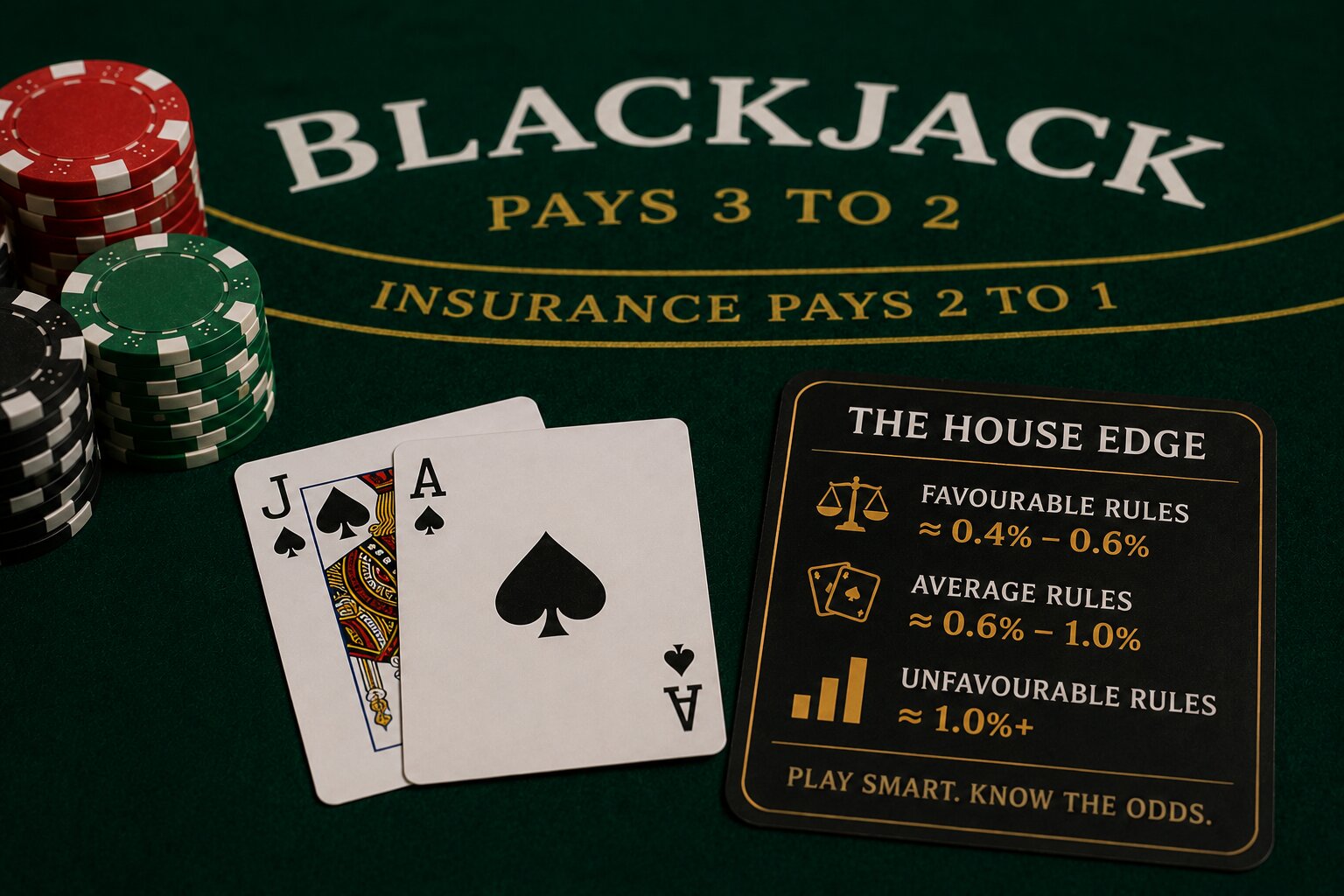
The house edge is the casino’s long-term mathematical advantage on a game.
If a game has a house edge of 1%, that means the casino expects to retain an average of £1 for every £100 wagered over a very large number of bets. This does not mean every player loses exactly £1 per £100. Short-term results can vary dramatically.
A player can win in one session. Another player can lose much more than the theoretical average. The house edge is not a prediction of what will happen today. It is a long-term measure.
In blackjack, the house edge is especially interesting because it depends on both the rules and the way the player makes decisions.
A player using blackjack basic strategy for beginners may face a much lower house edge than someone guessing every hand.
Why Blackjack Has A House Edge
At first glance, blackjack can look quite fair.
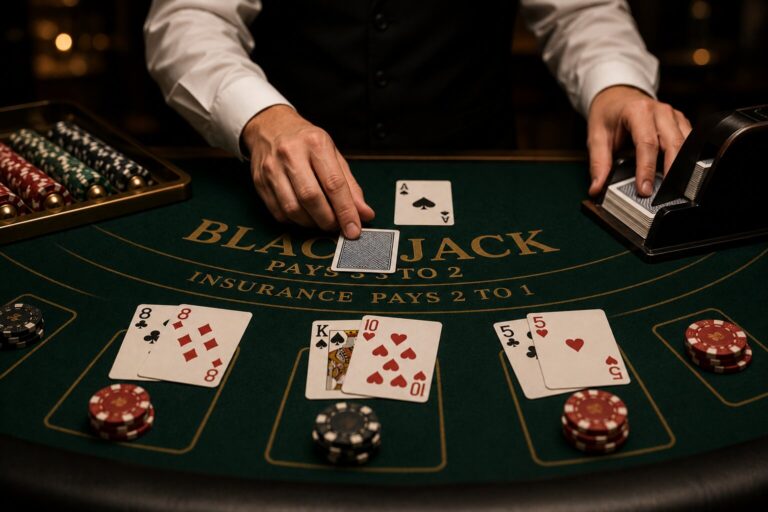
The player has choices. The dealer has fixed rules. Both sides are trying to avoid going over 21. The player can win, lose, push, double down, split pairs, and sometimes surrender.
So why does the casino still have an edge?
The main reason is that the player acts first. If the player goes over 21, the hand loses immediately. This is true even if the dealer would later have gone bust as well.
That single structure gives the house an important advantage.
The dealer may look restricted because they cannot choose freely, but the game is arranged so that player busts are settled before the dealer completes the hand. Over time, this helps the casino.
This is one of the most important ideas in blackjack rules explained, because it shows why the game is not simply a fair race to 21.
House Edge Is Not The Same In Every Blackjack Game
There is no single blackjack house edge that applies to every table.
Different rules change the maths.
A blackjack game with player-friendly rules may have a low house edge when played correctly. A game with poor rules may be much worse for the player, even if the game looks similar on the screen or table.
Important rule differences include:
how much blackjack pays
whether the dealer hits or stands on soft 17
whether doubling is allowed after splitting
whether surrender is available
how many decks are used
whether pairs can be re-split
how split aces are handled
whether side bets are included
This is why players should not judge blackjack only by the name of the game. Two tables can both be called blackjack but offer different long-term value.
The Importance Of Blackjack Payouts
One of the biggest house edge factors is the blackjack payout.
A natural blackjack is a two-card 21 made with an ace and a 10-value card. In many traditional games, blackjack pays 3:2. That means a £10 bet wins £15.
Some games pay 6:5 instead. In that case, a £10 bet wins only £12.
That difference may not seem huge on one hand, but it has a major effect over time. Since blackjacks are among the player’s strongest outcomes, reducing the payout makes the game significantly worse.
For beginners, this is one of the simplest table-selection rules to remember. A 3:2 blackjack game is usually much more attractive than a 6:5 game.
Good strategy matters, but so does choosing a fairer table in the first place.
Dealer Hits Or Stands On Soft 17
Another important rule is what the dealer does on soft 17.
A soft 17 is a hand that includes an ace counted as 11. For example, ace and 6 can be counted as 17 or 7.
Some games require the dealer to stand on soft 17. Others require the dealer to hit soft 17.
When the dealer hits soft 17, the house edge usually increases. That is because the dealer gets another chance to improve a flexible hand without the same bust risk as a hard total.
Players may not notice this rule immediately, but it matters. It is often shown on the blackjack table layout or in the game rules panel online.
Small rule differences like this are central to understanding blackjack odds when playing by the book.
Number Of Decks
The number of decks used can also affect the house edge.
Blackjack may be played with one deck, two decks, six decks, eight decks, or another shoe format. In general, fewer decks can be better for the player, all else being equal, but the actual value depends on the full rule set.
Casinos may balance single-deck or double-deck games by adding less favourable rules, such as reduced blackjack payouts.
This is why players should not assume that a single-deck game is automatically better. If the payout is poor or doubling rules are restricted, the game may still be unfavourable.
The full package of rules matters more than one feature on its own.
Doubling Rules And The House Edge
Doubling down is one of the strongest player options in blackjack.
It allows the player to increase the original bet in favourable situations and receive exactly one more card. When used properly, doubling helps the player take advantage of strong starting hands.
Rules around doubling can change the house edge.
A game that allows doubling on any two cards is generally better for the player than one that restricts doubling to certain totals. A game that allows doubling after splitting is also usually better than one that does not.
The reason is simple. More flexible doubling gives the player more chances to make high-value decisions.
This connects directly to common blackjack strategies, because doubling is not just a rule. It is one of the most important strategic tools in the game.
Splitting Rules And The House Edge
Splitting pairs also affects the house edge.
When players can split pairs, re-split certain hands, and double after splitting, they have more ways to improve awkward or promising hands.
For example, splitting 8s can help avoid playing a difficult hard 16. Splitting aces can create two strong starting hands. If re-splitting is allowed, the player may have even more flexibility.
However, restrictions can reduce player value. Some games limit re-splitting. Some allow only one card after splitting aces. Some do not allow doubling after a split.
These details may seem technical, but they affect the long-term maths.
A beginner does not need to memorise every rule variation immediately, but they should understand that splitting rules are part of the house edge.
Surrender And Player Value
Surrender is a rule that allows the player to give up the hand and lose only half the original bet.
It is not available in every game. When it is available, it can be valuable in specific poor situations.
Some beginners dislike surrender because it feels negative. But from a mathematical point of view, surrender can reduce losses when a hand is especially weak against the dealer’s upcard.
The key is using it correctly. Surrendering too often is not good strategy. Ignoring surrender completely when it is available can also be a mistake.
A table that offers surrender may be slightly better for the player than one that does not, depending on the other rules.
Basic Strategy And The House Edge
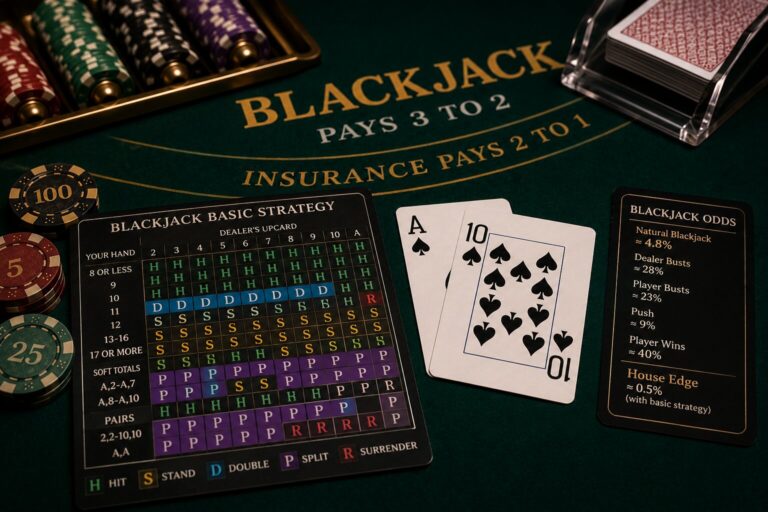
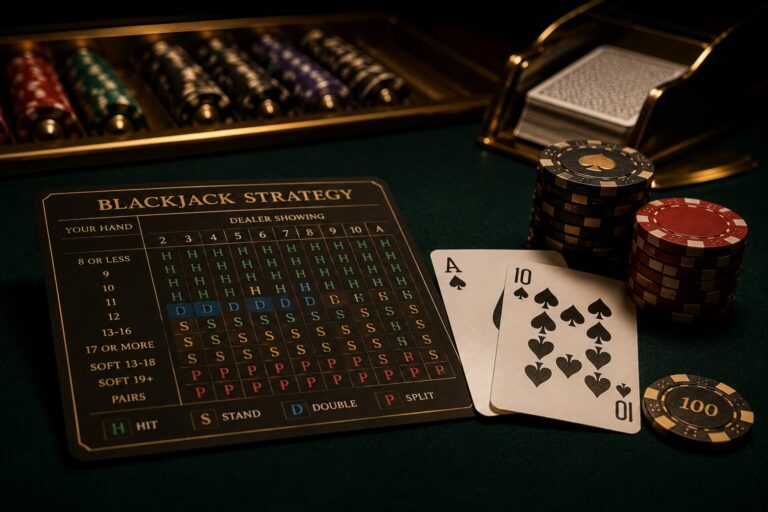
Basic strategy is the main tool ordinary players use to reduce the blackjack house edge.
It tells players the recommended move for each hand, based on the player’s total and the dealer’s upcard. It covers hitting, standing, doubling, splitting, and sometimes surrender.
Without basic strategy, many players make costly mistakes. They stand too often on weak hands, take insurance, split poor pairs, refuse good doubles, or chase decisions based on instinct.
With basic strategy, those mistakes are reduced.
This does not mean the house edge disappears. In normal casino conditions, the casino usually still has an advantage. But the difference between guessing and playing correctly can be significant.
That is why when to hit or stand in blackjack is not just a beginner topic. It is part of controlling the long-term cost of the game.
How Mistakes Increase The House Edge
The published or theoretical house edge usually assumes correct play.
If a player makes frequent mistakes, their personal effective house edge becomes worse.
For example, taking insurance regularly can add poor-value bets. Splitting 10s can weaken a strong hand. Refusing to double in strong situations can reduce potential returns. Chasing losses can increase exposure during emotional play.
These mistakes do not always lose immediately. A player may make a poor decision and still win the hand. That is one reason blackjack can be deceptive.
But over many hands, bad decisions tend to cost money.
This is why avoiding blackjack mistakes that you should look to avoid is not just about looking knowledgeable at the table. It directly affects the player’s long-term position.
Side Bets And The House Edge
Many modern blackjack games include side bets.
These side bets might pay for pairs, suited combinations, perfect 21s, or other special outcomes. They can make the game more exciting, but they often carry a higher house edge than the main blackjack game.
This creates a problem for players who are trying to keep the house edge low.
A player may follow basic strategy well on the main hand but place side bets every round. If those side bets are high-edge wagers, the overall cost of play can increase sharply.
Side bets are not automatically wrong if the player treats them as entertainment and understands the risk. But they should not be confused with improving blackjack odds.
For lower-edge play, the main hand is usually the focus.
Insurance And The House Edge
Insurance deserves special attention because it is one of the most common blackjack side bets.
When the dealer shows an ace, players may be offered insurance. The bet wins if the dealer has blackjack and usually pays 2:1.
The name makes it sound protective, but it is really a separate bet on the dealer’s hidden card.
For most casual players, insurance is usually not worth taking. Without information about the remaining cards, the bet generally favours the house.
This is a classic example of how a rule can look useful while still increasing the casino’s advantage. Understanding the house edge helps players see beyond the language used at the table.
Card Counting And The House Edge
Card counting is famous because, under the right conditions, it can potentially shift the edge toward the player.
The basic idea is to track the balance of high and low cards remaining in the deck or shoe. When the remaining cards are rich in high cards, the player may be in a stronger position.
However, card counting is not easy. It requires practice, concentration, proper game conditions, bankroll discipline, and the ability to avoid casino attention. Many modern blackjack games are designed to make counting harder, especially online games that shuffle frequently.
For ordinary players, card counting is not a simple solution to the house edge.
It is more relevant when discussing professional blackjack players and how they win than when explaining casual blackjack strategy.
Can The House Edge Be Beaten?
The house edge can sometimes be overcome by skilled advantage players under specific conditions.
That may involve card counting, team play, promotions, rule opportunities, or other forms of advantage play. But this is not the same as ordinary recreational blackjack.
For most players, basic strategy reduces the house edge but does not create a long-term player edge.
This is why claims about beating blackjack should be treated carefully. There is a major difference between improving your odds and expecting reliable profit.
A useful companion question is can you win at blackjack without counting cards? The answer is yes in the short term, but short-term wins do not mean the house edge has disappeared.
Online Blackjack And House Edge
Online blackjack can have different house edge considerations from land-based blackjack.
Standard digital blackjack games usually display their rules in an information section. These rules should be checked before playing. Some games may have reasonable conditions, while others may include less favourable payouts or restrictions.
Live dealer blackjack uses real cards and a real dealer, but it still depends on table rules. The fact that the game is live does not automatically make it better or worse.
Online blackjack can also move faster than a physical casino table. Faster play means more hands per hour, which can increase the amount wagered over a session.
Even if the house edge is low, playing many hands quickly can increase total exposure.
Why Casinos Offer Low-Edge Blackjack
If blackjack can have a low house edge, why do casinos offer it?
There are several reasons.
First, many players do not use perfect strategy. Second, some players choose poor rules. Third, side bets can increase casino revenue. Fourth, blackjack attracts players and keeps them engaged.
Casinos also think in terms of large numbers. A small edge over many hands can still be profitable.
This is part of how online casinos make their money. The business model does not require every player to lose quickly. It relies on long-term margins, game volume, and consistent mathematical advantage.
Blackjack can be relatively player-friendly compared with some games, but it still works within that structure.
Comparing Blackjack With Other Casino Games
Blackjack’s house edge can be lower than many casino games when played correctly.
However, this depends on the rules and the player’s decisions. A poorly played blackjack game with side bets may be worse than a simple game with clear odds.
Roulette, for example, has a more fixed house edge based on the wheel type and bet payouts. Players can choose different types of bets, but they cannot change the underlying wheel odds once the spin begins.
That makes roulette rules and strategy different from blackjack strategy. Roulette strategy is mostly about bet selection and risk management. Blackjack strategy affects decisions inside the hand.
Both games involve risk. The difference is how the player interacts with the house edge.
Responsible Ways To Think About The House Edge
Understanding the house edge should make blackjack clearer, not more dangerous.
A low house edge should not encourage bigger bets, longer sessions, or the belief that losses are unlikely. Even low-edge games can produce losing streaks. Variance is real.
A responsible blackjack approach includes setting a budget, choosing suitable stakes, avoiding emotional decisions, and accepting that losing is possible even when playing correctly.
The house edge is a useful guide to long-term value, but it does not protect any single session.
Players should treat blackjack as entertainment, not as a way to generate income.
Guest Posts On Blackjack Maths And Casino Education
Lucky252Casinos welcomes clear, informative guest posts from writers who can explain blackjack, casino maths, game rules, house edge, or wider iGaming topics in a responsible way. We are interested in practical articles that help readers understand risk and probability without exaggerating the chances of winning.
Would you like to write for us about casino games? We would welcome your input.
A Clear Way To Understand Blackjack House Edge
The blackjack house edge is the casino’s long-term advantage, but it is not fixed in the same way for every version of the game.
Rules matter. Payouts matter. Dealer procedures matter. Player decisions matter.
A player who learns basic strategy, avoids insurance, understands doubling and splitting, and chooses better table rules can usually reduce the house edge. A player who guesses, chases losses, and plays side bets without understanding them may increase it.
Still, blackjack remains gambling. A lower house edge does not guarantee a winning session, and correct play does not remove variance.
The practical goal is not to pretend the house edge does not exist. It is to understand it clearly, reduce avoidable mistakes, and approach the game with realistic expectations.