Professional Blackjack Players: How Are They Winning?
Professional blackjack players are often misunderstood.
Films, books, and casino stories can make professional blackjack look like a glamorous shortcut. A player learns one secret system, walks into a casino, wins a fortune, and leaves before anyone notices.
Real blackjack advantage play is much less simple.
Professional players do not usually win because they are lucky, fearless, or following a magic betting pattern. They win, when they win, because they understand the maths of the game, look for favourable conditions, manage risk carefully, and stay disciplined for long periods.
Even then, professional blackjack is not easy. It involves variance, pressure, casino scrutiny, bankroll swings, and a constant need to find playable games.
For ordinary players, the point is not to copy professionals blindly. It is to understand what professional blackjack actually involves and how different it is from casual casino play.
What Makes A Blackjack Player Professional?
A professional blackjack player is not simply someone who plays often.
A professional player is usually trying to make decisions based on expected value rather than entertainment alone. They are looking for situations where the long-term maths may favour them, or where the casino’s normal edge is reduced enough to create an opportunity.
That is very different from a recreational player who sits down for fun, plays a few hands, and hopes for a good session.
Professional players may use card counting, team play, rule analysis, promotions, rebates, or other advantage-play methods. They also need strong bankroll management because even good opportunities can produce losing runs.
This is why professional blackjack should not be confused with ordinary blackjack basic strategy for beginners. Basic strategy is the starting point. Professional play goes further.
They Start With Perfect Basic Strategy
Professional blackjack players generally know basic strategy extremely well.
They do not stop to guess whether a hand should be hit, stood, doubled, split, or surrendered. Those decisions are automatic because hesitation and inconsistency create errors.
Basic strategy tells players the correct standard decision based on their hand and the dealer’s visible card. It reduces the house edge and prevents many common beginner mistakes.
However, basic strategy alone does not usually create a long-term player advantage in normal casino conditions. It is the foundation, not the whole building.
A professional player starts with basic strategy because every advanced method depends on it. If a player cannot handle ordinary decisions correctly, they are not ready for advantage play.
They Understand The House Edge Deeply
Professional blackjack players think in terms of house edge, expected value, and variance.
They know that blackjack is not one fixed game with one fixed cost. The house edge changes depending on rules, payouts, number of decks, dealer procedures, surrender options, doubling rules, split rules, and player decisions.
A game where blackjack pays 3:2 is usually better than one where blackjack pays 6:5. A game where the dealer stands on soft 17 is usually better for the player than one where the dealer hits soft 17. A game that allows doubling after splitting can be better than one that does not.
These details matter. A casual player may see two tables that both say blackjack. A professional player sees two different mathematical environments.
This is why understanding blackjack and the house edge is central to serious play.
Card Counting Is The Famous Method
Card counting is the best-known professional blackjack method.
The idea is that the cards already dealt give information about the cards likely to remain. If the remaining shoe contains a higher proportion of 10-value cards and aces, the player may be in a more favourable position.
A card counter tracks this balance using a counting system. When conditions are poor, they may bet smaller or avoid play. When conditions are favourable, they may increase their stake and sometimes adjust specific playing decisions.
This does not mean the counter knows the next card. It also does not mean every favourable count produces a win. It means the player may have a long-term edge if the method is applied correctly under suitable conditions.
Card counting is powerful in theory, but difficult in practice. It requires concentration, discipline, speed, accuracy, and emotional control.
Card Counting Is Not A Magic Trick
One of the biggest myths about professional blackjack is that card counting guarantees winning.
It does not.
A card counter can lose many hands in a row. They can have losing sessions, losing weeks, and difficult bankroll swings. The edge, when it exists, is usually small and only shows itself over many hands.
This is why professional blackjack requires a different mindset from casual play. A recreational player may judge a decision by whether it won the hand. A professional player judges it by whether it was positive expected value.
This difference is hard for beginners. A correct play can lose immediately. A poor play can win once. Professionals understand that one result proves very little.
That same lesson applies to ordinary players learning when to hit or stand in blackjack. The correct decision is not always the one that wins the next hand.
They Look For Good Game Conditions
Professional blackjack players do not treat every blackjack table as worth playing.
They look for conditions that make advantage play possible. This may include favourable rules, enough deck penetration before the shuffle, suitable table limits, reasonable game speed, and less restrictive betting conditions.
Deck penetration is especially important for card counters. If the casino shuffles too early, the counter has less opportunity to benefit from favourable card composition.
Game speed also matters. More hands per hour can mean more opportunities, but it can also mean more pressure and faster swings.
Professional players are selective. They may walk away from games that casual players would happily play.
For beginners, this reinforces a simpler lesson: blackjack rules and how they work matter before you ever place a bet.
Bet Spreading Is Part Of The Method
Card counting is not only about tracking cards. It is also about changing bet size.
When the count is unfavourable, the player wants less money at risk. When the count is favourable, they may bet more.
This is called bet spreading.
The challenge is that large bet changes can attract attention. A player who bets the minimum for several rounds and suddenly jumps to a much higher stake may stand out.
Professional players therefore need to balance mathematical value with practical table awareness. They want to make enough from favourable situations without making their play too obvious.
This is one reason professional blackjack is more difficult than simply learning a count. The maths and the casino environment both matter.
Some Professionals Use Team Play
Blackjack teams became famous because they allowed players to separate roles.
One player might sit at a table and count quietly while making smaller bets. Another player, sometimes called a big player, might enter when the count becomes favourable and place larger bets.
Team play can make advantage play more efficient, but it also adds complexity. Teams need trust, training, shared bankroll rules, accurate records, clear signals, and strong discipline.
A weak team can fail quickly. Miscommunication, ego, poor accounting, or emotional betting can damage the whole operation.
This is very different from casual blackjack. It is closer to running a small, high-risk business than simply playing cards for fun.
That is why stories about famous blackjack teams should be read carefully. They are interesting, but not easy to copy.
They Manage Bankroll Like A Professional Tool
Bankroll management is one of the biggest differences between professional and casual blackjack.
A professional bankroll is not just “money to gamble with”. It is working capital. It must be large enough to survive variance and structured enough to avoid ruin.
Even if a player has an edge, they can still go broke by betting too aggressively. A small edge with oversized bets is dangerous.
Professionals think about risk of ruin, session limits, unit size, bet spread, and how much of the bankroll can be exposed at one time.
Casual players can learn from this without pretending to be professionals. A recreational player should still decide a budget before playing and avoid chasing losses.
Good bankroll control will not remove the house edge, but it can help keep gambling within planned limits.
They Avoid Poor-Value Bets
Professional blackjack players usually avoid bets that do not fit their edge.
Insurance is a good example. For most casual players, insurance is usually poor value. But a card counter may sometimes take insurance when the count suggests there are enough 10-value cards left to make it worthwhile.
That difference is important. The same option can be bad for one player and useful for another, depending on information.
Side bets are similar. Many side bets have a high house edge, so professionals usually avoid them unless they have a specific advantage.
For beginners, the safer lesson is simple: avoid assuming that every extra bet is helpful. Many side bets make blackjack more expensive over time.
They Exploit Rules And Promotions Carefully
Not every professional blackjack opportunity comes from card counting.
Some players look for unusual rule sets, promotions, rebates, loyalty offers, or temporary casino conditions that change the value of play.
This can be complicated. A promotion may look generous but include restrictions. Online bonuses may have wagering requirements, maximum bet limits, game weighting rules, or exclusions.
Professional players read details carefully. They do not assume an offer is profitable just because it sounds attractive.
This connects to how online casinos make their money. Casino offers are usually designed with long-term commercial value in mind. A serious player studies the terms before deciding whether an opportunity is real.
They Stay Emotionally Controlled
Professional blackjack depends heavily on emotional control.
A player may do everything correctly and still lose for hours. They may increase bets at favourable counts and lose those large hands. They may watch a weaker player win while they lose using the better method.
That can be frustrating.
A professional cannot respond by chasing losses, changing the system emotionally, or increasing stakes outside the plan. Discipline is not optional. It is part of the edge.
This is also one of the biggest lessons for casual players. Many blackjack mistakes that you should avoid are emotional rather than technical. Chasing losses, copying others, overbetting, and abandoning strategy can all make the game worse.
They Keep Records
Serious blackjack players track results.
They may record hours played, locations, rules, stakes, win or loss amounts, expenses, conditions, and observations about each game. This helps them understand whether their approach is actually working.
Without records, it is easy to rely on memory. Gambling memory is often unreliable. Players remember big wins, painful losses, and dramatic hands more clearly than ordinary sessions.
Professional players need a realistic view of performance. Records help separate expectation from emotion.
A casual player does not need a professional spreadsheet, but keeping a simple record of gambling spend can support better control.
They Know When Not To Play
One of the most underrated professional skills is walking away.
A professional player may skip a game because the rules are poor, the table is too crowded, the shuffle is too shallow, the limits are unsuitable, or the casino attention is too strong.
This is not exciting, but it is important.
Recreational players often sit because they want action. Professional players are more selective because not every game is worth playing.
That mindset is useful even outside blackjack. In casino games such as roulette, players cannot create the same kind of card-counting edge, but they can still choose whether a game fits their budget and expectations. Understanding roulette rules and strategy can help players see the difference between game structure, risk, and realistic decision-making.
Online Blackjack Is Harder For Professionals
Professional blackjack is usually associated with live, shoe-dealt games.
Online blackjack often makes traditional card counting difficult or impossible. Many digital games shuffle after each hand. Even live dealer games may use procedures, deck penetration, and platform rules that limit counting opportunities.
That does not mean no advantage opportunities ever exist online, but they are not as simple as counting cards in a traditional shoe game.
For ordinary players, online blackjack should be approached carefully. Check the rules, understand the pace, avoid poor side bets, and remember that fast gameplay can increase total wagering quickly.
Live dealer presentation does not remove the house edge.
Can Professionals Always Win?
No.
Professional blackjack players can have losing sessions. They can make mistakes. They can face poor conditions. Their edge can be smaller than expected. They can be restricted from games. They can misjudge variance.
The idea that professionals always win is misleading.
Professional play is about long-term expectation, not guaranteed results. Even with an edge, results can be uneven.
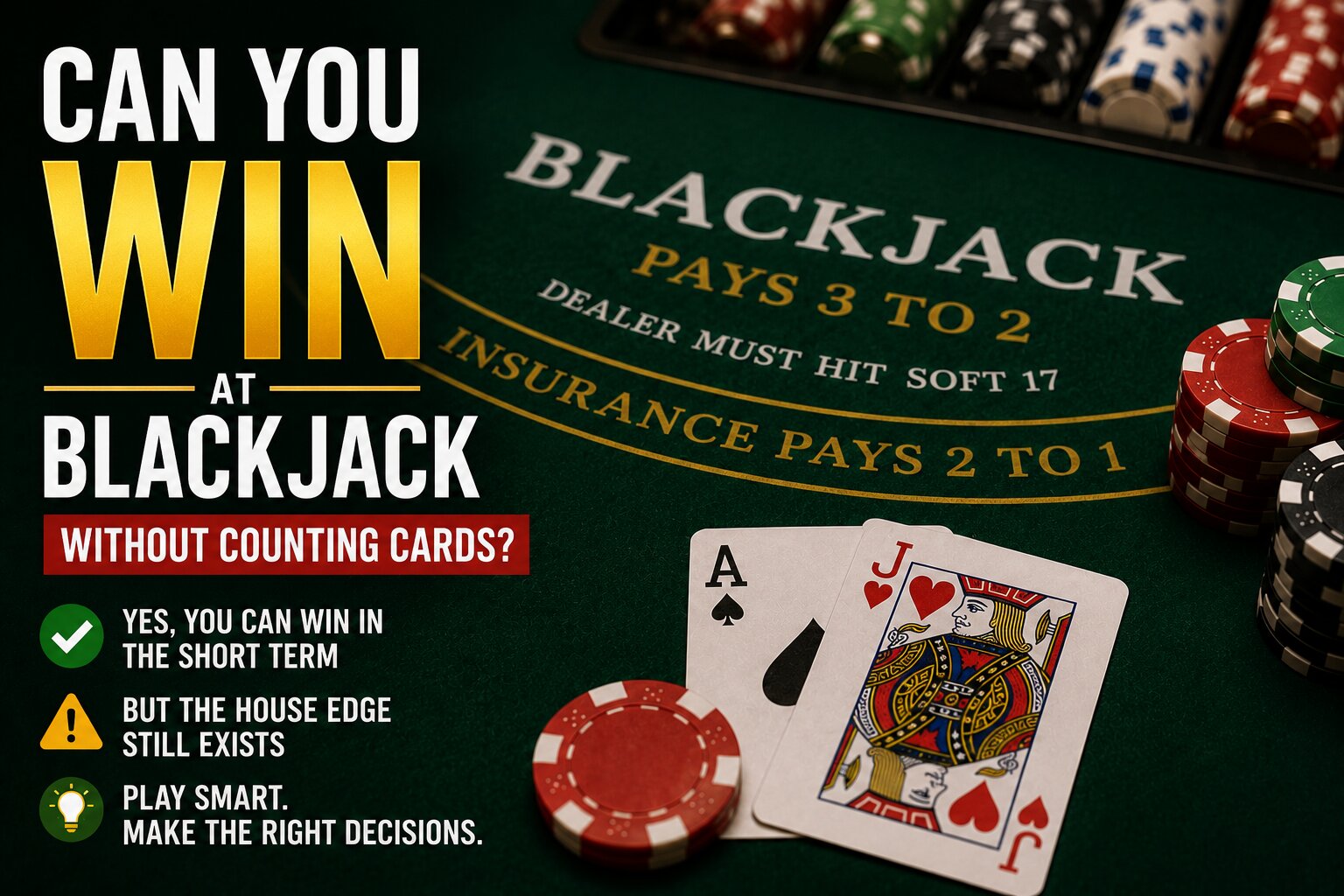
This is important for casual players asking can you win at blackjack without counting cards. Short-term wins are possible for almost anyone. Long-term professional winning requires something much more structured than luck or basic strategy alone.
How Professional Play Differs From Playing By The Book
Playing by the book means following basic strategy.
That is a strong approach for ordinary players. It reduces mistakes and can lower the house edge in suitable games.
Professional play goes further. It asks whether the game can become positive expectation. That may involve counting cards, changing bet sizes, using team methods, exploiting rules, or identifying special conditions.
So blackjack odds if you play by the book are not the same as professional blackjack odds. A basic strategy player is usually reducing the casino’s advantage. A professional is trying to find moments where the player may have the advantage.
That difference matters.
Can Ordinary Players Learn From Professionals?
Yes, but they should take the right lessons.
The lesson is not that blackjack is easy money. It is not that every player should try card counting immediately. It is not that betting bigger after a win or loss creates an edge.
The useful lessons are more practical.
Learn the rules. Use basic strategy. Choose better table conditions. Avoid weak bets. Manage your bankroll. Keep emotions under control. Understand the house edge. Do not chase losses. Treat short-term wins carefully.
These lessons can help ordinary players approach blackjack more responsibly, even if they never play professionally.
Guest Posts On Professional Blackjack And Casino Strategy
We are interested in informative articles that help readers understand casino games realistically without suggesting that gambling is an easy or reliable way to make money. If you’re like to write for us on casinos and igaming, then get in touch.
A Realistic Way To Understand Professional Blackjack
Professional blackjack players win, when they win, by treating the game very differently from casual players.
They study rules, understand house edge, use basic strategy perfectly, look for favourable conditions, manage bankroll carefully, and sometimes use advanced methods such as card counting or team play.
None of this makes blackjack risk-free. Professional players still face variance, losing streaks, casino restrictions, and practical challenges. Their success depends on discipline and edge, not luck alone.
For ordinary players, the best takeaway is not to chase a professional fantasy. It is to respect the difference between recreational blackjack and advantage play.
Blackjack can be strategic and interesting, but it remains gambling. The sensible approach is to learn the game, make informed decisions, manage risk, and keep expectations grounded.