Slots Tips and Strategies
Online slots are often described as the simplest casino games to play. There are no complex rules to learn, no decisions to make during gameplay, and no need to understand advanced systems. You choose a game, set your stake, press spin, and wait for the outcome.
Because of that simplicity, many players assume there is little to think about when playing slots.
However, while slots do not involve the same kind of decision-making as games like blackjack, there are still important concepts that affect how you play, how long your balance lasts, and how you experience the game overall.
This guide looks at slot tips and strategies from a practical, beginner-friendly perspective. It does not promise ways to “beat” slots, because that is not how they work. Instead, it focuses on understanding the mechanics, managing your play, and avoiding common mistakes.
Understanding What Slot Strategy Really Means
Before getting into specific tips, it is important to clarify what “strategy” means in the context of slot games.
Unlike blackjack or poker, slots do not offer meaningful in-game decisions that can change the odds of each spin. The outcome of every spin is determined by a random number generator (RNG), which ensures that results are independent and unpredictable.
This means there is no strategy that can guarantee wins or consistently overcome the house edge.
So what can strategy do?
In slots, strategy is about:
- choosing the right types of games for your preferences
- managing your balance and stake size
- understanding how features and volatility affect gameplay
- approaching bonuses in a practical way
In other words, slot strategy is less about influencing outcomes and more about controlling how you play.
How Slot Games Actually Work
To use any slot tips effectively, you need a basic understanding of how the games operate.
Every spin on a slot is random. The game uses software to generate a random result the moment you press spin. That result determines which symbols appear on the reels.
There is no memory of previous spins.
This is one of the most important points for beginners. A slot machine does not “know” whether it has paid out recently or whether it is “due” to hit. Each spin is independent of the last.
This has a few key implications:
- long losing streaks can happen
- wins can cluster together randomly
- patterns you think you see are usually coincidence
Understanding this helps avoid one of the biggest beginner traps: trying to predict outcomes in a game that is designed to be unpredictable.
Choose Games Based on RTP and Volatility
While you cannot influence the outcome of spins, you can choose which games to play. That choice can affect your overall experience.
Two of the most important concepts here are RTP and volatility.
RTP (Return to Player)
RTP is a percentage that represents how much a slot is expected to return to players over a very long period of time.
For example, a slot with 96% RTP is designed to return £96 for every £100 wagered over many thousands or millions of spins.
It is important to understand that RTP is a long-term average, not a guarantee for individual sessions.
Still, many players prefer slots with higher RTP because, over time, they tend to offer slightly better value than lower-RTP games.
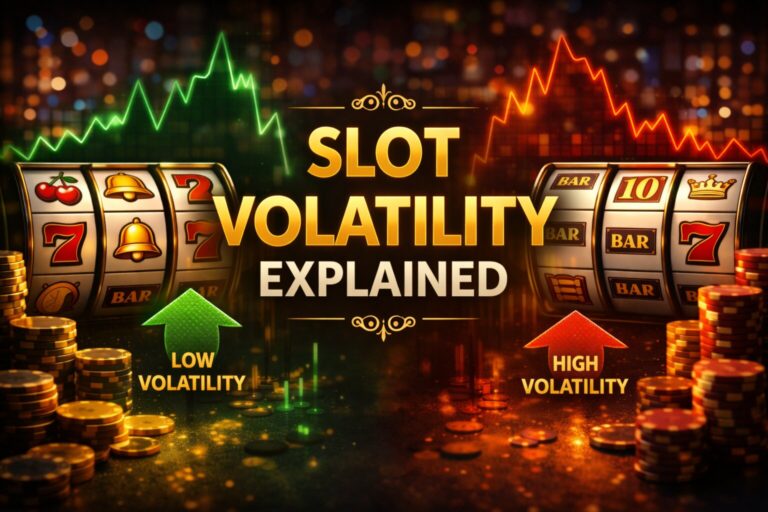
Volatility (Variance)
Volatility describes how a slot pays out.
- low volatility: smaller wins, more frequently
- high volatility: larger wins, less frequently
Neither is inherently better. It depends on what kind of experience you want.
Low-volatility slots can make your balance last longer and provide more regular feedback. High-volatility slots can feel slower but may offer bigger individual payouts.
Choosing a volatility level that matches your expectations is one of the most practical “strategy” decisions you can make.
Set a Budget Before You Start
One of the simplest and most effective slot tips is also one of the most overlooked: decide how much you are willing to spend before you begin playing.
Slots can move quickly, especially online. Spins happen in seconds, and features like autoplay can make it easy to lose track of time and spending.
Setting a clear budget helps avoid this.
A good approach is:
- decide on a fixed amount for a session
- treat that amount as the total cost of entertainment
- avoid adding more funds mid-session
This keeps your play controlled and reduces the risk of chasing losses.
Manage Your Stake Size Carefully
Your stake size has a direct impact on how long your balance lasts.
Many beginners choose a stake that is too high relative to their balance. This can lead to very short sessions, especially on higher-volatility slots.
A common guideline is to aim for a stake that allows a reasonable number of spins within your budget.
For example, if your budget is £50, placing £5 per spin will lead to very quick results. Placing £0.50 per spin allows for a longer session and more time to experience the game.
This is not about finding the “perfect” bet size, but about matching your stake to your goals.
If you want a longer, more relaxed session, lower stakes usually make more sense.
Avoid Chasing Losses
Chasing losses is one of the most common mistakes in slot play.
This happens when a player increases their stake or continues playing beyond their planned budget in an attempt to recover previous losses.
The problem is that slots do not adjust outcomes based on your previous results. Increasing your stake does not make a win more likely. It only increases how much you risk on each spin.
A more sustainable approach is to accept that losses are part of the game and stick to your original limits.
Understand Bonus Features Before You Play
Modern slot games often include a range of features, such as:
- free spins
- bonus rounds
- multipliers
- expanding wilds
- cascading reels
These features are often where the most interesting gameplay happens, and in some cases, where the largest wins can occur.
However, not all features work in the same way.
Before committing to a game, it can help to understand:
- how bonus features are triggered
- whether features can re-trigger
- how often features typically appear (linked to volatility)
This helps set realistic expectations and avoids confusion during play.
Be Careful With Autoplay
Autoplay allows the game to run multiple spins automatically without manual input.
While convenient, it can make it easier to lose track of how much you are spending and how quickly your balance is changing.
If you use autoplay, consider setting limits such as:
- number of spins
- stop-loss limits
- stop-win limits
These settings can help keep control over your session, even when spins are happening automatically.
Slot Bonuses and Strategy Considerations
Casino bonuses can play a role in how you approach slots.
For example, free spins are usually tied directly to specific slot games or categories. Deposit bonuses often come with wagering requirements that are typically completed by playing slots.
However, it is important to understand that bonuses do not change how the slot itself works. The game remains random.
What bonuses can affect is:
- how much you can play for your deposit
- how long your balance lasts
- how wagering requirements influence your game choice
When using bonuses, it is worth checking:
- which games contribute to wagering
- whether there are stake limits while the bonus is active
- any restrictions on winnings
This helps avoid misunderstandings later.
Don’t Fall for Slot Myths
Slots are surrounded by myths, especially online. Many of these ideas sound convincing but are not based on how the games actually work.
“The slot is due to pay”
Slots do not track previous outcomes in a way that makes a win “due.” Each spin is independent.
“Stopping and restarting changes your luck”
Reloading a game or switching slots does not influence the RNG outcome.
“Certain times of day pay more”
Online slots are software-based and do not change behaviour based on time.
Understanding these myths helps players avoid making decisions based on false assumptions.
Try Different Types of Slots
Not all slot games feel the same.
Some are simple and fast-paced, with classic layouts and fewer features. Others are more complex, with multiple bonus rounds, story elements, and evolving mechanics.
Trying different types of slots can help you figure out what you enjoy most.
For example:
- classic slots for simplicity
- video slots for features and visuals
- high-volatility slots for larger potential wins
- low-volatility slots for steadier play
This is less about strategy in a mathematical sense and more about finding a style of game that suits your preferences.
Know When to Stop
One of the most important habits in slot play is knowing when to stop.
This applies both to losing sessions and winning sessions.
If you reach your planned budget, it is usually best to stop rather than continue chasing a turnaround.
Similarly, if you hit a good win, some players choose to stop or reduce their stake rather than continuing at the same level.
There is no single rule here, but having some kind of stopping point helps keep your play controlled.
Responsible Play and Expectations
Slots are designed as entertainment. They are not a reliable way to make money.
Even with high RTP and careful bankroll management, the house edge remains. Over time, the game is structured to return less than the total amount wagered.
That is why it is important to approach slots with the right expectations.
Playing with money you can afford to lose, setting limits, and understanding how the games work all contribute to a more balanced experience.
A Practical Approach to Slot Play
For beginners, slot strategy is not about finding a way to beat the system. It is about making informed choices that improve how you experience the game.
That includes:
- choosing games with suitable RTP and volatility
- managing your budget and stake size
- avoiding common myths and mistakes
- understanding how bonuses fit into the picture
Slots remain games of chance, but a more informed approach can make them feel less confusing and more controlled.
Ultimately, the best “strategy” for slots is not about predicting outcomes. It is about understanding the structure of the game and playing in a way that aligns with your expectations, limits, and preferences.