What Is RTP in Online Slots?
When people start comparing online slot games, one of the first terms they come across is RTP. It appears in reviews, game info panels, casino guides, and promotional descriptions, often presented as if it gives a quick answer to whether a slot is “good” or “bad.”
In reality, RTP is useful, but it is also one of the most misunderstood concepts in online casino gaming.
A lot of players see a figure like 96% RTP and assume it tells them what they personally are likely to get back from a short session. Others ignore RTP entirely and focus only on theme, bonus features, or jackpots. Neither approach gives the full picture.
To understand online slots properly, it helps to know what RTP actually means, what it does not mean, how it relates to volatility, and why two slots with similar RTP figures can still feel completely different to play.
This guide breaks RTP down in simple terms, so beginners can understand how it works and more experienced players can place it in the right context when comparing games.
What does RTP mean?
RTP stands for Return to Player.
It is a theoretical percentage that represents how much a slot game is designed to return to players over a very large number of spins.
For example, if a slot has an RTP of 96%, that means that, in theory, for every £100 wagered across a huge sample of play, the game would return about £96 to players over time. The remaining £4 would represent the casino’s edge.
That sounds straightforward, but the phrase “over time” is the most important part.
RTP is not a promise about what will happen in your next ten spins, your next hundred spins, or even your next few sessions. It is a long-run theoretical figure based on the mathematics built into the game.
So when people say a slot has a 96% RTP, they are talking about the game’s design, not a guaranteed personal result.
Why RTP matters
RTP matters because it gives players one useful way to compare slot games.
If you are looking at two slots that are otherwise similar, and one has an RTP of 94% while the other has an RTP of 96.5%, many players would consider the second game more attractive from a long-term value perspective.
That does not mean it will definitely perform better in a short session. It simply means the game is theoretically built to return a higher percentage of wagered money over extended play.
For players who care about game comparison, RTP can help answer questions like:
- Is this slot relatively generous compared with others?
- Is this a low-return game dressed up with strong branding or flashy features?
- Does this slot offer a better long-term profile than another one in the same category?
RTP is especially useful when comparing slots within the same general type, such as classic slots, feature-heavy video slots, or jackpot games.
What RTP does not mean
This is where many misunderstandings happen.
A slot with 96% RTP does not mean:
- you will get £96 back for every £100 you spend
- you are likely to lose only £4 in a session
- you are due a win if you have been losing
- the machine will “balance out” in the short term
- the game is safer or less risky in every respect
All it means is that the game is designed to return that amount in theory, across a very large volume of total play.
A player could spend £20 and win nothing. Another player could spend £20 and win £200. Another could lose steadily over a week. Another could hit a large feature or bonus round in the first few spins.
All of those outcomes can exist within the same RTP framework because slots are random in the short term.
The importance of “theoretical” return
The word theoretical is essential.
Online slots use a random number generator, often shortened to RNG, to determine outcomes. This means each spin is independent, and each result is generated according to the game’s programmed probabilities.
Over millions of spins, the outcomes may resemble the slot’s intended RTP more closely. But in real life, most players do not experience millions of spins on a single game under identical conditions. They experience short or medium-length sessions, where variance can have a major effect.
This is why RTP should be treated as a mathematical guide, not a session forecast.
Think of it as a description of the game’s long-run architecture rather than a prediction of your personal experience.
A simple example of how RTP works
Imagine an online slot with an RTP of 96%.
If that game were played for a massive number of spins, with enough total wagers to smooth out short-term fluctuations, the theoretical return might approach 96% overall.
In a simplified model:
- total wagered: £1,000,000
- theoretical returned amount: £960,000
- theoretical retained amount: £40,000
That £40,000 would roughly represent the house edge over that huge sample.
But this does not mean every block of £100 bet returns £96 neatly. In real play, results jump around constantly. Some spins return nothing. Some return small wins. Some trigger bonuses. A few may produce large payouts.
The path is uneven, even though the long-term design points toward a general return percentage.
House edge and RTP
RTP is closely connected to the house edge.
If a slot has an RTP of 96%, the house edge is 4%.
If a slot has an RTP of 94%, the house edge is 6%.
That relationship is simple:
House Edge = 100% – RTP
This is one reason players compare RTP figures. A lower RTP means the casino’s theoretical advantage is higher.
That said, house edge alone still does not tell you how a game will feel in the short term. Two slots may have similar RTP values but very different gameplay experiences because of volatility, hit frequency, bonus structure, and payout distribution.
RTP versus volatility
If RTP is one of the most misunderstood slot terms, volatility is probably the second.
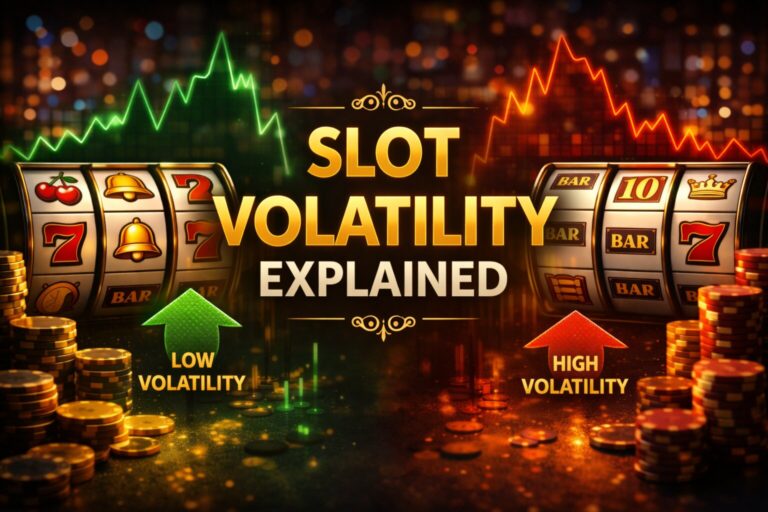
Volatility refers to the style of risk and reward in a slot. In simple terms, it gives a sense of how wins tend to be distributed.
A low-volatility slot may:
- produce smaller wins more often
- feel steadier
- offer fewer dramatic swings
A high-volatility slot may:
- produce longer losing stretches
- deliver fewer but larger wins
- feel more unpredictable and intense
This is why RTP alone is not enough.
A 96% low-volatility slot and a 96% high-volatility slot may have the same theoretical return, but the player experience can be completely different.
One may feel active and steady, with regular smaller returns. The other may feel harsh for long periods and then deliver occasional large payouts.
So when comparing slots, RTP tells you something about long-term value, while volatility helps tell you how the journey may feel.
Why two slots with similar RTP can still feel different
This is one of the most important practical points for players.
Imagine these two games:
- Slot A: 96.1% RTP, low volatility
- Slot B: 96.0% RTP, high volatility
On paper, they look almost identical in RTP terms. But in play, they may behave very differently.
Slot A may:
- land smaller line wins more frequently
- feature modest bonus rounds
- feel more forgiving over short sessions
Slot B may:
- offer fewer base-game wins
- rely more heavily on bonus features
- have the potential for much bigger payouts
- feel much rougher in the short term
A player who likes longer sessions and less dramatic swings might prefer Slot A. A player chasing bigger moments might prefer Slot B.
That is why experienced players rarely look at RTP in isolation.
RTP and hit frequency
Another useful concept is hit frequency.
Hit frequency refers to how often a slot tends to produce any kind of win. This is separate from how big those wins are.
A slot could have:
- fairly frequent small wins
- but still be quite volatile if meaningful wins are rare
Or it could have:
- less frequent wins overall
- but larger average wins when they do occur
Hit frequency, RTP, and volatility all interact, but they are not the same thing.
For a beginner, the main takeaway is simple:
- RTP tells you about theoretical long-run return
- volatility gives a sense of risk pattern
- hit frequency suggests how often wins may appear
Together, they give a more rounded picture than RTP alone.
Where players can usually find RTP
RTP is often available in one or more of these places:
- the game’s paytable or information screen
- the rules/help section inside the slot
- casino game descriptions
- slot review sites
- game provider materials
Not every casino displays RTP clearly on the lobby page, and not every player checks it before spinning. But it is often available somewhere if you look at the game information closely.
If a casino or game page makes strong claims about a slot but does not clearly explain anything about RTP, volatility, or features, that usually means you need to look deeper before drawing conclusions.
Does a higher RTP always mean a better slot?
Not necessarily.
A higher RTP is often attractive, but it does not automatically make one slot better than another for every player.
Some players care most about:
- feature variety
- theme and presentation
- jackpot potential
- bonus rounds
- volatility profile
- stake range
- mobile experience
A slot with slightly lower RTP but stronger features may still appeal more to a player than a mathematically better but less engaging game.
There is also the issue of game type. Progressive jackpot slots, for example, can have different value perceptions because players may be drawn by the jackpot potential rather than by a higher base RTP.
So while RTP is a good comparison point, it should not be treated as the only factor that matters.
RTP and progressive jackpot slots
Progressive jackpot slots need a bit of extra context.
In a progressive game, part of the total wager pool may feed the jackpot. This can affect how players evaluate the game’s value, because some of the appeal lies in the possibility of a very large top prize.
A progressive slot may not feel attractive if you only look at base return characteristics. But players interested in life-changing jackpots may view it differently.
This is another reminder that player preferences vary. Someone focused on steady entertainment may prefer a medium-volatility slot with a transparent RTP around the mid-90s. Someone chasing a rare huge payout may willingly accept a different profile.
Can RTP vary between casinos?
Sometimes, yes.
Some slot providers offer games in multiple RTP configurations. That means the same slot title may not always have exactly the same RTP at every casino.
For example, one operator may offer a version at a higher RTP, while another may use a lower setting. That is one reason why checking game details can matter, especially if you are comparing the same slot across multiple sites.
This is also why broad statements such as “this slot has X RTP” can occasionally be incomplete unless the exact version is known.
For players, the practical lesson is:
- do not assume every casino offers the identical configuration
- check the in-game information where possible
Why short sessions can be misleading
One of the biggest traps for new players is drawing conclusions from very short sessions.
For example:
- “This slot says 96%, but I lost ten spins in a row.”
- “This game must have high RTP because I won quickly.”
- “This slot has gone cold.”
- “This one is due to pay.”
None of these statements reflects how RTP works.
Short sessions are heavily influenced by randomness. A game can perform badly in a session and still have a strong RTP. Another can produce a quick win and still have a lower RTP overall.
Humans are naturally drawn to patterns, especially when money is involved. But slot outcomes are not designed to create neat short-term balance.
The safest mindset is to treat any short session as an unreliable sample.
Common myths about RTP
Myth 1: A 96% slot gives back £96 from every £100
This is the classic misunderstanding. RTP is a long-run theoretical average, not a personal spending guarantee.
Myth 2: A slot will soon pay if it has been losing
Each spin is independent. Previous results do not force the next spin to become a winner.
Myth 3: Higher RTP means lower risk
Not always. A high-RTP slot can still be highly volatile.
Myth 4: RTP is the only number that matters
It matters, but it needs context. Volatility, features, and game structure matter too.
Myth 5: You can feel RTP in a short session
Usually not. Short sessions are too random to reliably reflect the theoretical long-run design of a slot.
How beginners should use RTP
For a new player, RTP is best used as a comparison tool, not a prediction tool.
A sensible beginner approach looks like this:
- check the RTP if it is available
- look at the volatility or game style
- review the paytable and bonus features
- decide whether the slot suits your preferences
- keep stakes sensible and expectations realistic
In other words, RTP should help you ask better questions, not make you assume a certain outcome.
A practical way to compare slots
If you are comparing two or three slot games, use a simple checklist:
- RTP
- volatility
- jackpot or non-jackpot
- bonus features
- stake range
- theme and play style
- mobile usability
- whether the game feels suited to short or longer sessions
This gives you a fuller picture than just picking whichever slot has the highest percentage.
For example, you may decide:
- one slot has slightly lower RTP but a better feature set for your tastes
- one has strong RTP but high volatility you do not enjoy
- one offers a better all-round balance for beginners
That is a more useful way to think about slot selection.
RTP and responsible play
RTP can be a helpful educational tool, but it should never be treated as a reason to keep spending.
A misunderstanding that sometimes creeps in is:
- “This slot has a decent RTP, so I should keep going.”
- “The maths says I should get some of it back.”
- “If I play long enough, the RTP will work in my favour.”
That is not how responsible play works.
RTP is not a recovery mechanism. It does not erase risk. It does not make further spending safer. It does not guarantee anything for an individual session.
A healthier approach is:
- set a budget before you play
- treat RTP as background information, not a promise
- stop when you reach your limit
- avoid chasing losses
- remember that all slot play involves risk
Final thoughts
RTP is one of the most useful numbers in online slots, but only when it is understood properly.
It tells you the game’s theoretical long-run return, not what you personally will get back in a session. It can help you compare one slot with another, but it does not replace other important factors such as volatility, hit frequency, bonus design, and overall style of play.
For beginners, the best way to use RTP is as part of a wider comparison process. A slot’s percentage may be worth noting, but it should sit alongside questions like:
- Is this game high or low volatility?
- Does it suit short sessions or bigger swings?
- Are the bonus features interesting?
- Is the stake level comfortable?
- Does the game actually match what I enjoy playing?
Used properly, RTP is a helpful guide. Used badly, it can create unrealistic expectations.
As with all casino games, online slots should be treated as entertainment, not as a way to make money. Understanding RTP can make players better informed, but it does not remove the risks involved. Always play responsibly and never spend more than you can afford to lose.